
Lower Carbon. Lower Cost. Smarter Bearing Strategy for Mining
The Challenge
Mining operations rely on large, critical bearings in mills, conveyors, and grinding systems. These components are traditionally replaced at high cost — both financially and environmentally. Manufacturing new bearings requires high energy consumption, raw material extraction, and transport logistics, resulting in a significant carbon footprint per bearing replaced.
Our Solution – Remanufacturing with Purpose
Recore Technologies specialises in the remanufacturing of large industrial bearings, restoring them to operational condition while significantly reducing environmental impact. This includes recovering usable components, reconditioning raceways, and validating dimensional integrity and performance.
Emissions Reduction Impact
Remanufacturing a bearing can reduce emissions by up to 65–90% depending on scope and condition.
Real Example – 240/750 BC Bearing:
- CO2e saved: 2,492 kg per bearing (~65% reduction)
- Weight: 1,065 kg
- New footprint: 3,834 kg CO2e
- Reman footprint: 1,342 kg CO2e
CO2 Comparison (240/750 BC)
New vs Remanufactured bearing emissions:
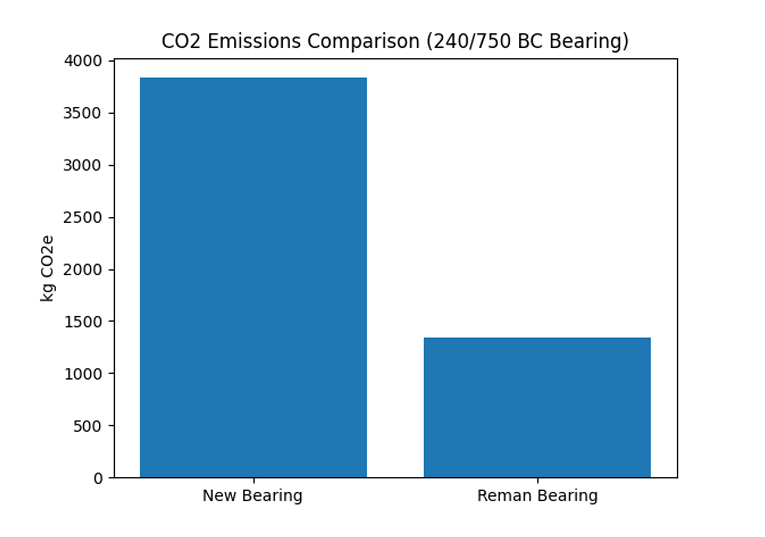
New: 3,834 kg CO2e
Reman: 1,342 kg CO2e
Saving: 2,492 kg CO2e (~65%)
HPGR Bearing Example
High Pressure Grinding Roll (HPGR) bearings are typically large, high-mass components similar in scale to 240/750 class bearings. Based on comparable sizes, each remanufactured HPGR bearing can deliver carbon savings in the range of 2–4 tonnes CO2e per unit, depending on size and remanufacturing scope.
Key Environmental Benefits
- Reduced raw material consumption
- Lower energy usage
- Reduced transport emissions
- Supports ESG and sustainability targets
- Contributes to Scope 3 emission reduction
Value to Mining Operations
- Lower cost compared to new bearings
- Reduced lead times
- Extended asset life
- Alignment with planned shutdowns
- Data-driven decision making when combined with condition monitoring
Remanufacturing Certification
Each remanufactured bearing is issued with a certificate including traceability, inspection results, scope of work, engineering validation, and emissions savings.